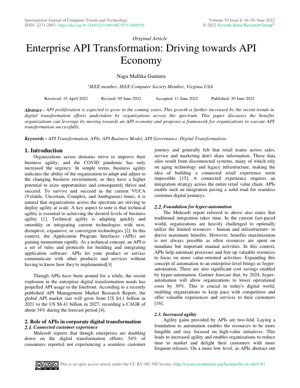
Enterprise API Transformation: A Framework for Driving the API Economy
Analysis of API proliferation, its role in digital transformation, and a proposed framework for organizations to successfully transition towards an API-driven business model.
Home »
Documentation »
Enterprise API Transformation: A Framework for Driving the API Economy
1. Introduction
In the current VUCA (Volatile, Uncertain, Complex, Ambiguous) business environment, achieving technical agility is paramount for organizational survival and success. This paper posits that Application Programming Interfaces (APIs) are a critical enabler of this agility. While APIs as a technical concept are not new, their strategic importance has exploded alongside enterprise digital transformation initiatives. The global API management market is projected to grow from $4.1 billion in 2021 to $8.41 billion in 2027, reflecting a compound annual growth rate (CAGR) of approximately 34%.
Market Forecast
API Management Market: $4.1B (2021) → $8.41B (2027)
CAGR: ~34%
Source: API Management Market Research Report
2. Role of APIs in Corporate Digital Transformation
APIs serve as the fundamental building blocks for modern digital ecosystems, enabling three key transformational outcomes.
2.1 Connected Customer Experience
Data silos and disconnected systems, often built on legacy infrastructure, create fragmented customer journeys. APIs act as universal connectors, enabling integration across the entire value chain. This integration is essential for creating a seamless, omnichannel customer experience, as highlighted by Mulesoft research indicating that 54% of consumers do not experience a seamless journey due to disconnected systems.
2.2 Foundation for Hyper-automation
APIs automate processes between applications, freeing human and infrastructural resources from mundane tasks. Scaling this automation to the enterprise level leads to hyper-automation. Gartner forecasts that by 2024, hyper-automation will enable organizations to reduce operational costs by 30%, providing a crucial competitive advantage.
2.3 Increased Agility
The agility benefits are twofold. First, automation via APIs allows resources to focus on high-value initiatives, accelerating time-to-market. Second, APIs abstract underlying implementation details, allowing systems to evolve independently. This decoupling is a core principle of microservices architecture, enabling faster, more frequent releases.
3. Proposed API Transformation Framework
While the paper outlines the "why," a successful transition requires a structured "how." Based on the discussion, a transformation framework can be inferred, moving from tactical integration to strategic business model innovation.
Foundation (Integration): Expose legacy system functions as internal APIs to break down data silos.
Productization: Package APIs as consumable products for internal developers and, potentially, partners.
Governance & Security: Implement API management platforms for lifecycle management, security (OAuth, rate limiting), and analytics.
Monetization & Ecosystem: Open select APIs to external developers, creating new revenue streams and innovation ecosystems—the core of the "API Economy."
4. Core Insight & Logical Flow
Core Insight: The paper's most potent argument isn't about technology—it's about business model evolution. It correctly identifies that APIs have transitioned from a backend integration tool to the primary currency of digital business value exchange. The real transformation is moving from viewing APIs as cost-center IT projects to treating them as revenue-generating product lines.
Logical Flow: The argument follows a compelling cause-and-effect chain: VUCA world → need for business agility → dependency on technical agility → APIs as the key enabler → tangible outcomes (connected experience, hyper-automation) → ultimate goal of participating in the API Economy. This flow mirrors the strategic shift observed in leaders like Amazon and Stripe, where internal efficiency tools (AWS APIs, payment APIs) became their core commercial offerings.
5. Strengths & Flaws
Strengths:
Business-First Lens: Successfully frames APIs in the context of business outcomes (agility, cost reduction, customer experience) rather than purely technical specs.
Timely Relevance: Leverages post-pandemic urgency for digital transformation and cites credible market data (Gartner, Mulesoft) to establish urgency.
Clear Value Proposition: Articulates the multi-faceted ROI from efficiency gains to new monetization avenues.
Critical Flaws & Omissions:
The Governance Gap: It mentions "API Governance" as a keyword but severely underplays the monumental cultural and organizational change required. Successful API programs, as documented by Google's API design guide philosophy, require centralized design review, consistent standards, and developer experience (DX) focus—topics barely scratched here.
Security as an Afterthought: The paper treats security as a checkbox within governance. In reality, API security is a primary attack vector (OWASP API Security Top 10). A transformation framework must bake in security-by-design from the start.
Missing Maturity Model: It lacks a concrete maturity model or metrics. How does an organization measure its progress from API chaos to API economy? Frameworks like the one from API Academy (SmartBear) provide stages (Initial, Managed, Defined, Measured, Optimized) that are crucial for roadmap planning.
6. Actionable Insights
For CXOs and architects, reading this paper should trigger specific actions:
Conduct an API Inventory & Audit: Before transformation, map all existing APIs (SOAP, REST, GraphQL). Categorize them by lifecycle, quality, and security posture. Tools like Postman or SwaggerHub can assist.
Establish a Center for Enablement (C4E): Don't just buy an API management platform. Create a cross-functional team (architecture, security, product, legal) to define standards, provide tools, and evangelize API-first design. This tackles the governance gap head-on.
Start with "API-as-a-Product" for One Domain: Choose a bounded domain (e.g., customer profile, product catalog). Build and govern its APIs as if they were external products. Measure usage, developer satisfaction, and reliability. This creates a blueprint and proves value before enterprise-wide rollout.
Treat Developer Experience (DX) as a KPI: The adoption of your API platform hinges on DX. Metrics should include time-to-first-call, documentation clarity scores, and support ticket resolution time. Excellent DX, as demonstrated by platforms like Twilio, is a competitive moat.
7. Technical Details & Mathematical Modeling
While the paper is strategic, the underlying technical value can be modeled. The benefit of API-led connectivity in reducing integration complexity can be expressed. In a point-to-point integration scenario, the number of connections grows polynomially with the number of systems $n$: $C_{p2p} = \frac{n(n-1)}{2}$. An API-led approach using a central layer (like an API gateway) reduces this to a linear growth: $C_{api} = n$. The complexity reduction factor $R$ is: $R = \frac{C_{p2p}}{C_{api}} = \frac{n-1}{2}$. For $n=10$ systems, $R = 4.5$, meaning the API approach is 4.5 times less complex to manage.
Hypothetical Experiment & Chart: A simulation could measure "Time to Integrate New System" (Y-axis) against "Number of Existing Systems" (X-axis) for both point-to-point and API-led architectures. The chart would show a steep, exponential-like curve for point-to-point integration, while the API-led approach would show a shallow, near-linear increase. This visually demonstrates the agility argument.
8. Analysis Framework: A Non-Code Example
Scenario: A traditional bank wants to enable third-party fintech apps to access (with customer consent) account balance information.
Framework Application:
Business Model Definition: Will this API be free (for ecosystem growth) or fee-based (per call, tiered subscription)?
API Design: RESTful endpoint GET /v1/accounts/{accountId}/balance. Use OAuth 2.0 for authorization. Response includes balance, currency, and as-of datetime.
Governance Check: The API C4E reviews design for consistency with other banking APIs, security compliance (PSD2/Open Banking standards), and documentation clarity.
Developer Experience: Provide a sandbox environment with mock data, interactive documentation (OpenAPI/Swagger), and SDKs in popular languages.
Analytics: Monitor API usage, error rates, and top-consuming fintech partners to inform future product decisions.
This non-code example illustrates the multi-disciplinary process beyond mere implementation.
9. Future Applications & Directions
The trajectory points beyond simple REST APIs:
Event-Driven APIs & AsyncAPI: Real-time business reactions will demand event-driven architectures. Standards like AsyncAPI for defining message-driven APIs will become as important as OpenAPI is today.
AI-Enhanced API Management: AI will be used for anomaly detection (security threats), predictive scaling, and automated optimization of API design based on usage patterns.
APIs for Composable Business: The ultimate expression of the API Economy is the "composable enterprise," where entire business capabilities (e.g., checkout, loyalty, fraud detection) are assembled from best-in-class internal and external APIs. Gartner identifies this as a key strategic trend.
Quantum Computing APIs: As quantum computing matures, cloud providers will expose its power via APIs, creating a new frontier for computational-intensive services in finance, logistics, and material science.
10. References
Leffingwell, D. (2010). Agile Software Requirements: Lean Requirements Practices for Teams, Programs, and the Enterprise. Addison-Wesley. (Cited for technical/business agility link).
Gartner. (2021). IT Glossary: Technical Agility. Retrieved from Gartner.com.
IBM Cloud Education. (2020). What is an API? Retrieved from IBM.com.
Market Research Future. (2022). API Management Market Research Report.